In the evolving landscape of search engine optimization, a backlink campaign remains one of the most powerful, and often misunderstood, strategies for improving a website’s organic visibility and authority. While algorithm updates in 2026 continue to refine how search engines evaluate content quality and user experience, the fundamental principle behind backlinks—acting as votes of confidence from one site to another—has only solidified its importance. Executing a successful backlink campaign isn’t about collecting links; it’s about strategically earning high-quality, relevant endorsements that tell search engines your site is a credible, valuable resource in its niche. It requires meticulous planning, genuine relationship building, and a deep understanding of what truly constitutes a valuable link.
What Exactly is a Backlink Campaign (in 2026)?
A backlink campaign, at its core, is a targeted and systematic effort to acquire inbound links (also known as backlinks) from other reputable websites to your own. In 2026, this isn’t simply a numbers game; it’s about quality, relevance, and naturalness. Google’s algorithms are increasingly sophisticated at discerning manipulative link schemes from genuinely earned editorial links. Therefore, a modern backlink campaign focuses on earning links that signal authority and trust to search engines, ultimately contributing to better rankings and increased organic traffic.
Think of it this way: when another respected website links to your content, they’re essentially vouching for its quality and utility. Search engines interpret these endorsements as a strong indicator that your content is valuable, authoritative, and worthy of higher placement in search results. The goal of a campaign is to intentionally create situations where these endorsements happen, building a robust, natural-looking link profile that strengthens your domain over time. This approach aligns perfectly with what constitutes good backlinks for SEO in the current environment.
Why Backlink Campaigns Remain Critical for SEO in 2026

A digital graph showing upward trends in organic traffic and search engine rankings, with various lines representing different SEO metrics, symbolizing the positive impact of backlink campaigns.
Despite rumors that backlinks might become less important, they continue to be a cornerstone of search engine optimization. Here’s why a focused backlink campaign is still vital in 2026:
Authority and Trust Signals
Backlinks are fundamental to establishing your website’s authority within its niche. When authoritative sites link to you, it transfers a portion of their trust and credibility. This “link equity” is a powerful signal to search engines that your site is a trustworthy source of information. Without a strong backlink profile, even the most expertly written content can struggle to rank against established competitors.
Improved Organic Rankings
Search engines use backlinks as a primary ranking factor. Pages with more high-quality backlinks generally rank higher in search results for relevant queries. A well-executed backlink campaign directly contributes to improving your keyword rankings, driving more organic visibility.
Increased Organic Traffic
Beyond direct ranking benefits, backlinks can send referral traffic. A link from a popular industry blog can bring a surge of visitors who are already interested in your topic. This traffic, especially if it’s high-quality and engaged, further signals to search engines that your site provides value, creating a positive feedback loop.
Faster Indexing and Discoverability
When search engine crawlers discover new content, they often do so by following links from already indexed pages. A robust backlink profile means your new content gets discovered and indexed more quickly, accelerating its potential to rank.
Enhanced E-E-A-T
Google’s emphasis on E-E-A-T (Experience, Expertise, Authoritativeness, and Trustworthiness) has grown significantly. High-quality, relevant backlinks serve as crucial third-party endorsements that validate your site’s expertise and authority. They demonstrate to search engines that others in your field recognize your contributions, directly enhancing your E-E-A-T signals. This is particularly important for sites operating in competitive or YMYL (Your Money Your Life) sectors.
The Core Components of a Successful Backlink Campaign Strategy
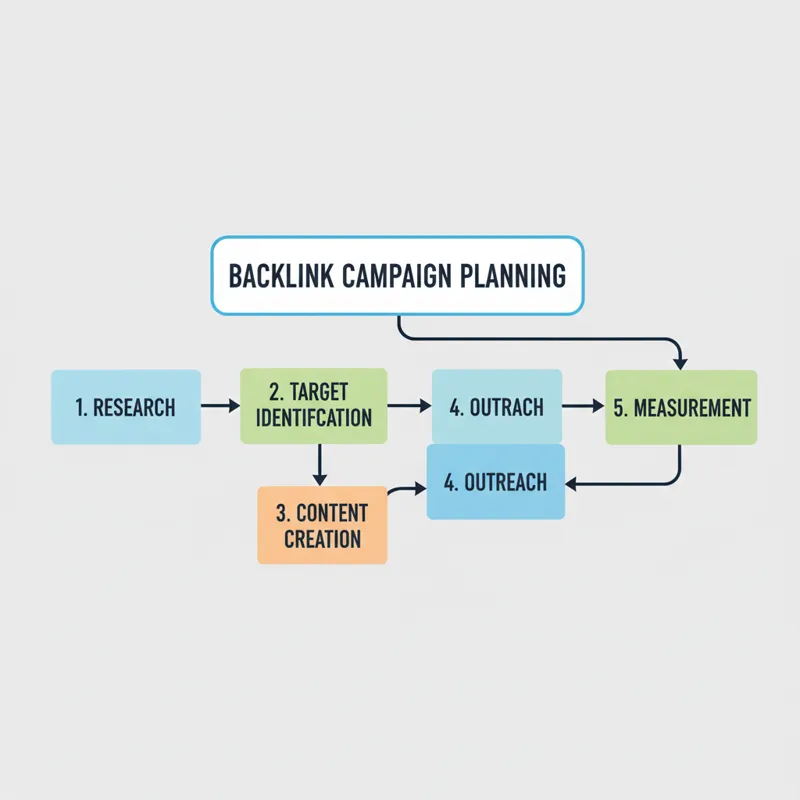
A clear, multi-step flowchart illustrating the stages of planning a backlink campaign, including research, target identification, content creation, outreach, and measurement, with arrows indicating flow and dependencies.
Building an effective backlink campaign isn’t a haphazard activity. It requires a strategic, step-by-step approach.
Setting Clear, Measurable Goals
Before you even think about outreach, define what success looks like. Are you aiming for a certain number of referring domains, an increase in domain authority, improved rankings for specific keywords, or a boost in organic traffic? Clear, quantifiable goals will guide your efforts and allow you to measure ROI. For example, “acquire 15 new, relevant backlinks from domains with a DR of 40+ within the next quarter” is a concrete goal.
Thorough Competitor Analysis
Understanding your competitors’ backlink profiles is invaluable. Tools allow you to see where your competitors are getting their links. This isn’t about copying; it’s about identifying opportunities and understanding the landscape. Look for patterns: what types of content do they get links to? Which sites consistently link to them but not to you? This can reveal untapped niches or highly receptive link sources. Learning about competitive backlinking can provide a significant advantage.
Identifying High-Value Link Targets
Not all links are created equal. Focus on quality and relevance. A high-value target site is:
-
- Relevant: It operates in a similar or complementary niche to yours.
- Authoritative: It has a strong domain rating (DR) or domain authority (DA) – look for high DA links.
- Trustworthy: It publishes high-quality content and isn’t associated with spam.
- Receives Traffic: Links from sites that actually get visitors are more valuable for referral traffic and signaling relevance.
This step often involves extensive research using SEO tools to filter and prioritize potential linking partners.
Content Strategy for Link Earning
Nobody links to mediocre content. Your best asset in a backlink campaign is exceptional, link-worthy content. This could be:
-
- Original Research or Data: Studies, surveys, or unique data analyses that others will want to cite.
- Comprehensive Guides: In-depth resources that serve as ultimate guides on a topic.
- Infographics and Visual Content: Easily shareable and digestible information.
- Tools or Calculators: Interactive assets that provide immediate value.
- Controversial or Opinion-Based Pieces: Content that sparks discussion and earns natural mentions.
Identify content gaps in your niche and create something demonstrably better or unique.
Ethical Outreach and Relationship Building
This is where the “campaign” aspect truly comes into play. Outreach involves contacting potential link partners with a compelling reason to link to your content. This isn’t about spamming; it’s about building genuine relationships.
-
- Personalization: Generic emails get ignored. Tailor each message to the recipient and their website.
- Value Proposition: Clearly explain why linking to your content benefits their audience.
- Brevity: Respect their time with concise, clear communication.
- Follow-Up: A polite follow-up can often turn a non-response into a link.
Many businesses also consider engaging a link building outreach service to handle this complex and time-consuming aspect professionally.
Types of Backlink Campaigns and Link Acquisition Tactics
Effective backlink campaigns employ a variety of tactics. Combining these approaches often yields the best results.
Resource Page Link Building
Many websites curate “resource” or “links” pages that list helpful external content for their audience. Identify these pages in your niche and propose your relevant, high-quality content as an addition. Search queries like “intitle:resources [your niche]” or “inurl:links [your niche]” can help uncover these opportunities.
Broken Link Building
This involves finding broken links (404 errors) on authoritative websites in your niche. You then reach out to the webmaster, inform them of the broken link, and suggest your own relevant content as a replacement. This provides immediate value to the webmaster by fixing an issue on their site and gives you a legitimate reason for outreach.
Guest Posting
Writing and publishing an article on another website is a classic tactic. In 2026, guest posting is effective only if it’s done ethically:
-
- The guest post must provide genuine value to the host site’s audience.
- The link back to your site should be natural and relevant within the content.
- Focus on high-authority, relevant sites; avoid low-quality guest post farms.
It’s about contributing valuable content to another community, not just inserting a link.
Skyscraper Technique
This involves finding the highest-ranking content for a relevant keyword, creating something significantly better or more comprehensive, and then reaching out to sites that linked to the original content to suggest they link to your superior version instead. This requires a substantial investment in content creation but can yield powerful links.
Unlinked Mentions
Sometimes, other websites mention your brand, product, or a specific piece of your content without actually linking to your site. Use tools to monitor these “unlinked mentions.” Reaching out to these site owners to politely request that they turn the mention into a clickable link is often a low-effort, high-reward tactic, as they already recognize your brand’s value.
Digital PR and Data-Driven Content
This advanced strategy involves creating truly newsworthy content—original research, groundbreaking studies, or compelling data visualizations—and then pitching it to journalists and media outlets. If your content gets picked up, it can result in high-authority links from news sites, major publications, and industry blogs. This is a powerful, albeit more demanding, form of link earning.
Niche Edits (Contextual Link Insertion)
Niche edits involve reaching out to website owners to ask if they would consider adding a link to your content within an existing, highly relevant piece of their content. The key here is relevance and providing a clear benefit to their audience. This can be a very effective way to get relevant backlinks directly within established content. However, this tactic needs careful execution to avoid appearing manipulative; the link must genuinely enhance the existing content.
Leveraging Internal Links for Authority Flow
While not strictly a backlink campaign in the traditional sense, optimizing your internal linking structure is crucial. It helps distribute link equity throughout your site, guiding search engines and users to important pages, and enhancing the overall authority of your domain.
What Most People Get Wrong About Backlink Campaigns
Even in 2026, several common misconceptions continue to undermine backlink campaign efforts. Avoiding these pitfalls is key to sustained success.
Prioritizing Quantity Over Quality
This is arguably the biggest mistake. A handful of highly authoritative, relevant links will always outperform hundreds of low-quality, spammy links. Google is incredibly adept at identifying and devaluing, or even penalizing, sites that engage in mass-produced, irrelevant link schemes. Focus on earning links that truly make sense for your niche.
Ignoring Relevance
A link from a high-authority site that has absolutely no thematic connection to your content holds little value, and can even be detrimental. If you’re selling specialty coffee beans, a link from an automotive repair blog makes no sense. Contextual relevance is paramount; it signals to search engines that your content is genuinely useful to a specific audience.
Relying Solely on Automated Outreach Tools
While automation can assist with list building and initial contact, solely relying on generic, templated emails for outreach is a recipe for failure. Personalization, genuine connection, and demonstrating you’ve actually read their content are what earn responses and links. People link to people, not robots.
Expecting Immediate Results
SEO, and particularly backlink campaigns, is a long-term strategy. It takes time for search engines to crawl new links, reassess your site’s authority, and adjust rankings. Expecting a dramatic jump in rankings within weeks is unrealistic. Consistent, ethical effort over months, even years, is what drives sustainable results.
Neglecting Content Quality
Many spend all their energy on outreach but forget that the foundation of any successful backlink campaign is truly exceptional content. If your content isn’t remarkable, nobody has a compelling reason to link to it. Invest heavily in creating resources that people genuinely want to reference and share.
Failing to Diversify Link Sources
A healthy backlink profile comes from a variety of sources. Relying too heavily on a single type of link (e.g., only guest posts or only directory submissions) can make your profile look unnatural. Seek a diverse range of links from different types of sites: blogs, news outlets, educational institutions, industry partners, forums, etc.
Measuring Success and ROI in Your Backlink Campaign
Measuring the effectiveness of your backlink campaign is crucial for understanding your return on investment and refining future strategies.
Key Metrics to Track:
-
- Referring Domains: The total number of unique websites linking to yours. This is a primary indicator of link acquisition progress.
- Domain Rating/Authority: A score (e.g., Ahrefs DR, Moz DA) indicating the strength of your website’s overall backlink profile. Increases here are a good sign.
- Organic Traffic Growth: The ultimate goal. Monitor changes in organic traffic, especially to pages targeted by your link building efforts.
- Keyword Ranking Improvements: Track the movement of your target keywords in search results. Direct correlation between new links and ranking jumps can indicate success.
- Brand Mentions: An increase in mentions (linked or unlinked) signals growing brand recognition and authority.
- Conversion Rates: If your campaign aims to drive specific business outcomes, track how organic traffic from improved rankings translates into leads, sales, or other conversions.
Attributing Success
Isolating the precise impact of a backlink campaign from other SEO efforts (like on-page optimization or technical SEO) can be challenging. However, by setting clear goals upfront, regularly monitoring the metrics above, and noting significant changes after concentrated link-building pushes, you can build a strong case for its ROI. Tools that track individual backlinks and their impact on specific page rankings are invaluable here. Remember, Google’s algorithms are complex, and many factors contribute to rankings, but a strong backlink profile is consistently one of the heaviest hitters. More information on Google’s ranking systems and how they evaluate links can be found on their Search Central documentation.
Ethical Considerations and Staying Google-Compliant (in 2026)
Google’s Webmaster Guidelines (now referred to as Google Search Essentials) explicitly warn against “link schemes” designed to manipulate PageRank. In 2026, these guidelines are more important than ever.
Focus on Earning, Not Buying
Google strongly advises against buying or selling links that pass PageRank. While guest posting or niche edits might involve some form of compensation for content creation or placement, the intent behind the link must always be editorial and natural, providing genuine value to the user. Any exchange of money for a link *intended to manipulate rankings* is a violation.
Relevance and Naturalness Above All
Every link you acquire should make logical sense. Would a real person, who genuinely found your content useful, naturally link to it from their site? If the answer is no, reconsider the link. Unnatural link profiles are a red flag for Google and can lead to manual penalties or algorithmic devaluations. The goal of any backlink campaign should be to appear as if links are being earned organically.
Disclose Paid Links with rel=”sponsored”
If there’s any form of compensation (monetary or otherwise) for a link, or if it’s an advertisement, it should carry a rel="sponsored" attribute. Similarly, user-generated content links (like forum comments) should use rel="ugc". These attributes tell Google not to pass PageRank, ensuring you stay compliant while still potentially driving referral traffic and brand mentions. This ensures transparency, which the Federal Trade Commission (FTC) also supports for consumer protection.
The Future of Backlink Campaigns: AI and Beyond
By 2026, artificial intelligence has profoundly impacted SEO, yet the core principles of backlink campaigns remain human-centric.
AI as an Assistant, Not a Replacement
AI tools are incredibly powerful for tasks like:
-
- Competitor Analysis: Rapidly identifying link gaps and opportunities.
- Content Ideation: Generating ideas for link-worthy content based on trending topics and gaps.
- Outreach Personalization: Helping to draft highly personalized email templates based on recipient data.
- Prospecting: Automating the discovery of relevant websites for outreach.
However, AI cannot replace the human element of judgment, creativity, and genuine relationship building. The nuances of crafting a compelling pitch, building rapport with webmasters, and understanding the true value of a link still require human intelligence and empathy.
Continued Emphasis on Genuine Value
The future will further reinforce the need for genuinely valuable content and ethical link acquisition. As search engines become even smarter at detecting manipulation, the focus will shift more intensely to content that naturally earns links because it’s exceptional, solves a problem, or provides unique insight. The barrier for “good enough” content to earn links will continue to rise.
Holistic SEO Integration
Backlink campaigns will be even more tightly integrated into a holistic SEO strategy. They won’t operate in a silo but will be intricately linked with content marketing, technical SEO, and user experience optimizations. A strong website foundation, great content, and a thoughtful backlink campaign will collectively drive success. Forbes has an excellent article on this topic, explaining the future of digital marketing and SEO trends.
Frequently Asked Questions About Backlink Campaigns
What’s a “good” number of backlinks to get?
There isn’t a magic number. What’s “good” depends entirely on your industry, your competitors, and your website’s current authority. Instead of focusing on quantity, prioritize acquiring a few high-quality, relevant links consistently over time. A campaign that brings in 5-10 strong links per month for a smaller site can be very successful.
How long does it take to see results from a backlink campaign?
Results typically aren’t immediate. You might start seeing minor improvements in rankings or traffic within 3-6 months for a consistent backlink campaign. Significant shifts usually take 6-12 months or even longer, especially in competitive niches. Patience and sustained effort are key.
Should I buy backlinks?
No. Directly buying links with the intent to manipulate search rankings is against Google’s guidelines and can lead to severe penalties, including manual actions that tank your site’s visibility. Focus on earning links through valuable content and genuine outreach. There’s a distinction between paying for content placement where the link is naturally earned, and outright purchasing a link solely for its SEO value.
How do I find contact information for outreach?
Several methods exist:
-
- Website Footers: Many sites list “Contact Us” or “Advertise” links.
- About Pages: Often contain email addresses or contact forms.
- Social Media: LinkedIn profiles can lead to email addresses.
- Hunter.io or Skrapp.io: Browser extensions that find email addresses associated with a domain.
- Google Search: Using queries like “site:example.com contact” or “example.com email” can sometimes reveal addresses.
Always prioritize finding a specific name and email for personalization.
Is link building still relevant with Google’s focus on content quality?
Absolutely. While content quality is paramount, backlinks act as validation of that quality from external sources. Think of it like a book: a well-written book needs good reviews and citations from other scholars to be recognized as authoritative. Your excellent content needs authoritative backlinks to truly shine in search results.